

Hello finance geeks 👋
For the past 20 years, investors like yourself have been known (and expected) to be very technical. If you wished to buy a stock, you’re expected to know how to read an Annual Report, but you don’t really know where to begin. Just the thought of reading a 400-page technical document may scare you even.
This extends to finding stock opportunities. There are a couple of ways to start here.
If you’re looking for a true top-down approach, you’d be expected to understand a sector. But after you lock-in to a sector, how do you find the stock with the best fundamentals and a big headroom for growth?
If you have a fair bit of idea on what you’re looking for, you might want to filter your way across. But do you filter on performance? Or do you look for price growth (momentum) or PAT growth (fundamentals)?
If you follow or respect a known investor, you’d most likely want to know how you can replicate them, but do you copy their portfolio (too late to get in) or do you wish to screen for stocks like they do?
If you noticed, in each of these scenarios, there are multitudes of questions that investors deal with, day in and day out.
Deciding an approach was only the beginning
Say you finally know what you want to screen for. Now you have to translate that into the exact language a screener understands. Most of these tools run on their own custom query syntax. One wrong keyword, a misplaced operator, a field spelled the way you’d say it rather than the way the tool stores it, and the screen returns nothing.
Obviously, creators thrive on this. You’d find hundreds of Twitter posts and YouTube videos that either teach you how to use traditional screeners OR nudge you to just “copy my screener”.
If you do end up learning the ropes or copying the screener, modifying it to your requirement is the next roadblock. Open the filter list and you’re staring at thousands of filters. By the time you’ve located it, added it, set the threshold and fixed the syntax, the question you started with has gone cold.
What if there was a simpler way to identify stocks to invest in?
In 2026, you should be able to just “prompt” what you want. You don’t need to read the 400-page annual report first. You don’t need to memorise whether the correct field is called “ROCE” or “Return on Capital Employed”. And you don’t need to decide upfront whether you’re filtering on momentum or on PAT growth.
Introducing Screeners on fuzz.
Describe the stocks you want and fuzz will build the Screener for you.
“What are the best AI and technology stocks in India to invest alongside Infosys”
“Low debt, fundamentally strong stock list for future growth”
“Show me stocks like Warren Buffett”
All of the above are “real” questions from users, each highlighting the pain-point we discussed above.
Under the hood, fuzz Screener understands close to 100+ financial fields, across valuation, growth, profitability, ownership and momentum, mapped to the names and conventions you already know from other tools. All of this is powered by Artham, our finance small-language-model, which figures out what you mean and routes it to the right fields.
If you’re still stuck on how to start, we’ve pre-curated some screeners for you to quickly begin.
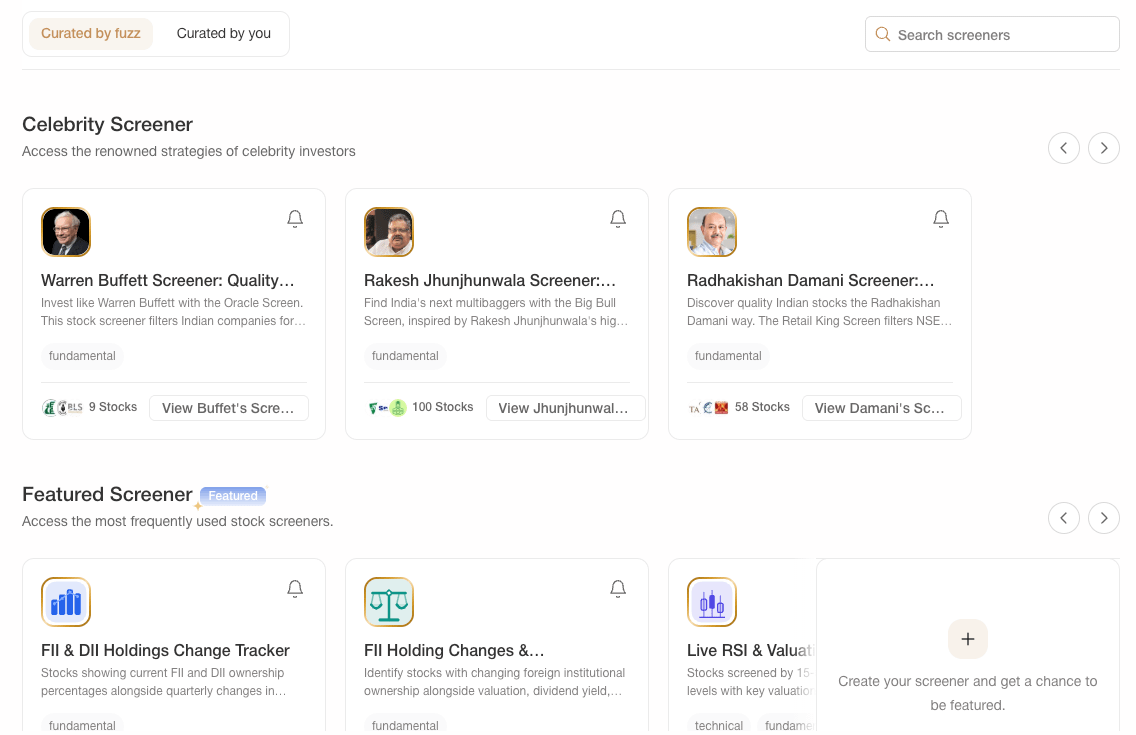
Whenever you create a Screener on fuzz, we automatically set alerts on it to notify you whenever a new stock appears (or disappears) from your list.
You can also share it with your friends (or followers 😉) to get ideas or help them create their own.
This is the future of screening. Not formulas and filters, but a question and a table you can trust and reshape, the way you want to. In your own language. You should be able to just search stocks like you think.
Hope you liked this blog! Share your feedback with us. You can write back to this email, drop a comment or shoot us an email at feedback@askfuzz.ai
That’s it for now.
fuzz is built to assist with financial research and learning. Please verify important information from original sources before making investment decisions. Nothing shared here should be treated as investment advice.
