

Hello finance geeks 👋
Last month, we highlighted how voice is acting as a key enabler for consumption of content in general. Within finance, a key ingredient to this is news. As fuzz is becoming a popular way to consume finance news in general, we decided to dive deeper into this.
Every day, even within finance, there are hundreds of trending topics to browse through. Most of these optimise for time-to-publish, rather than finer nuances such as impact and correlation with management commentary.
For example, yesterday, while most headlines just focused on Eicher Motors’ (Royal Enfield) announcement of a new facility in Andhra, few articulated how it is a sharp departure from it’s usual Tamil Nadu Cheyyar hub (all four of it’s current facilities are located there), as a strategic move to reduce dependency on one state, even though it is 2.5x more expensive.
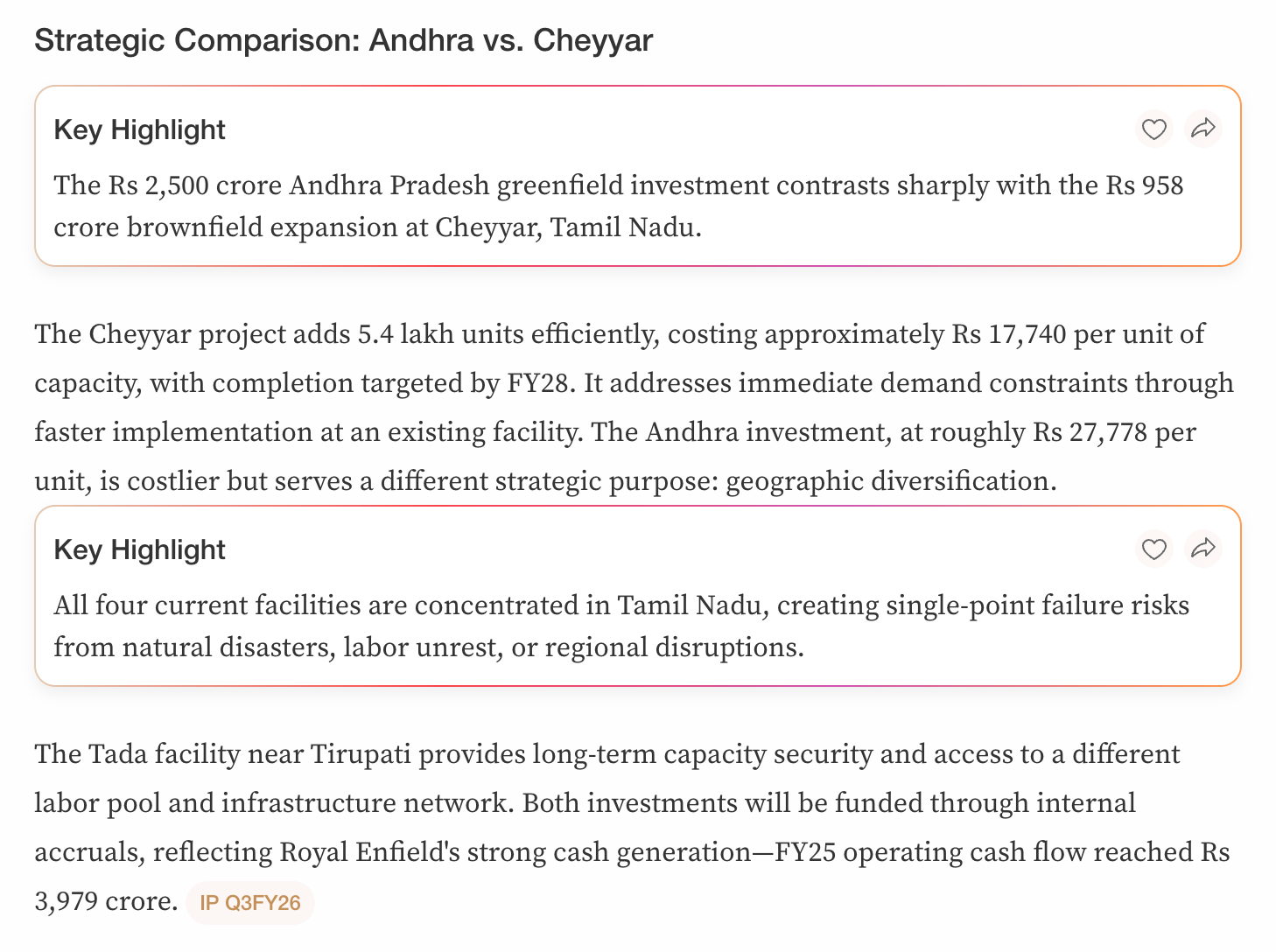
How are we able to extract these insights?
Introducing “Connect the Dots”
At fuzz, we’ve always believed in providing data which is grounded and useful, which our users can trust.
For a few trending articles, fuzz:
Extracts and maps the news to a listed company or sector in India
Analyses hundreds of sources (to ensure authenticity and relevance)
Goes back to check management commentary from official company filings (annual reports, past transcripts and investor presentations)
Connects the Dots across all of these to build source-backed insights
Let’s walk these through with an example.
Did you know just how much currency depreciation boosts IT stocks’ revenue?
fuzz picked the above as a trending topic, extracted listed entities such as TCS, HCL and Infosys, read through all of their concalls and investor presentations and analysed how rupee depreciation exactly impacts each of these entities. It also connected the dots across mid-cap IT companies to check if their impact is lower or higher.
Here’s a short glimpse of how we show the extract from the concall transcript directly in-line with the article, auto-highlighted as you click on the source.
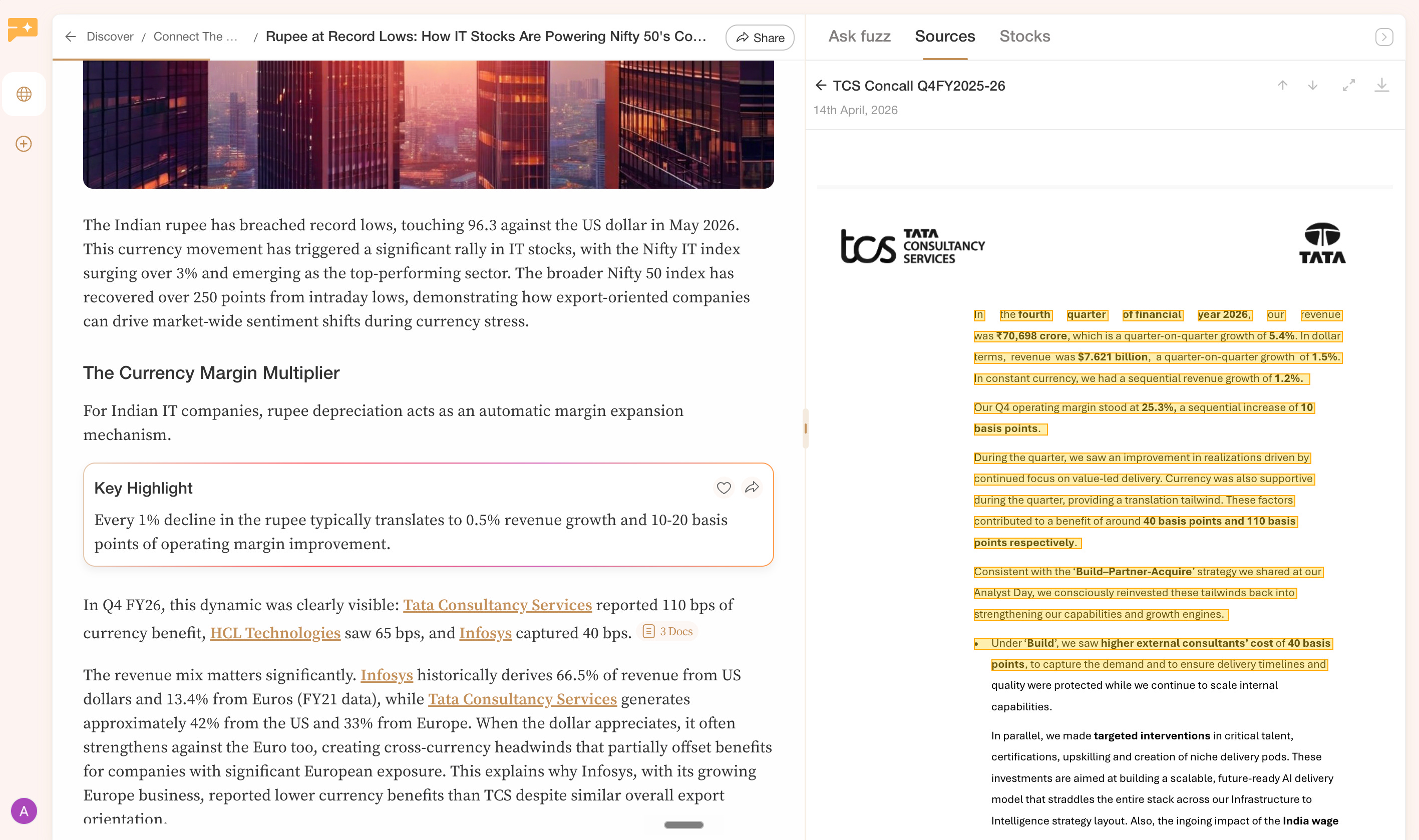
We believe that this is the future of financial content - from surface-level announcements to source-backed insights. And it’s only going to get better from here.
We’ve previously written about our proprietary financial small-language-model (Artham) which acts as the backbone of this causal analysis. It not only powers all financial content across fuzz, but also across the entire Raise ecosystem, including company news on ScanX and crypto news on upTrade.
Here’s an entire walk-through video on how we do this:
Each day, hundreds of users consume news across all of these platforms and ask questions to understand more about their preferred company or sector.
Our goal is simple.
Build an ecosystem where news isn’t just consumed, it’s understood; where every headline you read comes with the why, the context, and the sources, right alongside it.
This is the foundation we’re building. Connect the Dots is just the first step.
Follow us on socials
If you’d like these news to find you instead of the other way around, follow us on socials. We’ve created dedicated handles where we publish “Connect the Dots” daily.
🔗 On LinkedIn, we publish a longer-form newsletter every evening: ideal if you like reading with your coffee.
🐦 On Twitter/X, we break each Connect the Dots into a single tweet: ideal for quick scrolls between meetings.
Pick whichever fits your day.
Hope you liked this blog! Share your feedback with us. You can write back to this email, drop a comment or shoot us an email at feedback@askfuzz.ai
That’s it for now.
fuzz is built to assist with financial research and learning. Please verify important information from original sources before making investment decisions. Nothing shared here should be treated as investment advice.